
When Evidence Exists and Still Does Not Matter: The Killing of Renee Nicole Good and the Authoritarian Override of Reality
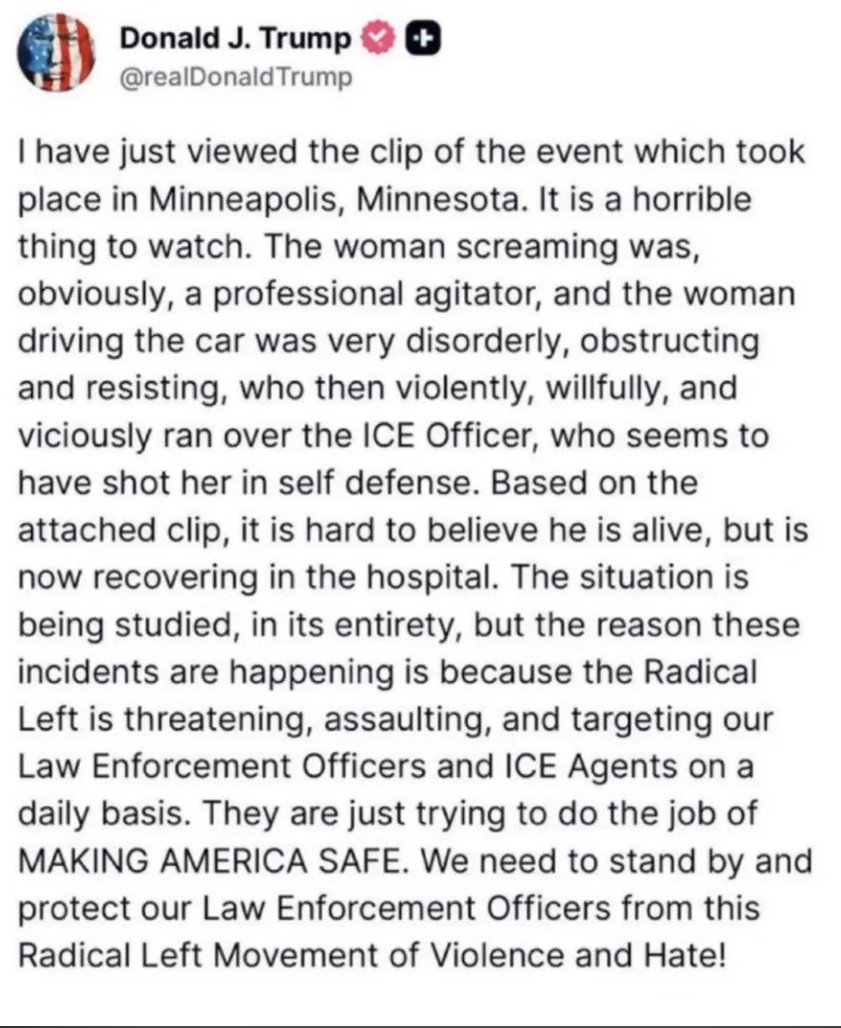
Source: Truth Social
Authoritarianism is often imagined as something that depends on secrecy. We think of media blackouts, censorship, crimes hidden from public view. That image is reassuring, because it suggests that as long as evidence exists, truth will eventually assert itself.
But that is not how modern authoritarianism works.
On January 7, 2026, Renee Nicole Good was killed by an agent of U.S. Immigration and Customs Enforcement (ICE) in Minneapolis during a ‘federal enforcement operation’. Video footage of the incident circulated almost immediately. Witnesses spoke publicly. Local officials disputed the federal account. The event was unresolved and under investigation.
And yet Donald J. Trump declared a complete moral narrative anyway.
Not cautiously.
Not provisionally.
As if the facts were already settled.
What makes this case so tragic is not just the killing itself, but how openly and quickly reality can be overwritten even when the evidence is visible and accessible. To understand how blatant this process has become, it is worth breaking down Trump’s statement line by line.
Step one: Evidence exists and is acknowledged
Trump begins his statement by saying:
“I have just viewed the clip of the event which took place in Minneapolis, Minnesota.”
This matters. He does not deny the footage exists. He does not claim the truth is unknowable. He does not suggest we lack information.
This immediately dismantles a common assumption people rely on when discussing state violence. The problem here is not ignorance. The evidence is acknowledged from the outset.
This tries to establishes authority. He has seen what you have seen. What follows therefore feels like clarification rather than distortion.
Step two: Emotional framing before factual reasoning
Trump follows with:
“It is a horrible thing to watch.”
This appears empathetic, but its function is emotional priming. Before facts are assessed, the audience is guided into a shared emotional state.
Authoritarian narratives rarely begin with claims. They begin with feelings. Once emotion is anchored, interpretation becomes easier to steer.
Step three: Delegitimising witnesses in advance
Trump then states:
“The woman screaming was, obviously, a professional agitator.”
No evidence is provided. None is required. The word “obviously” signals that disagreement is irrational by default.
This is a classic out group move. A person is not described by what they do, but by what they are. Once someone is an agitator, their presence becomes suspect. Their testimony becomes unreliable. Their distress becomes performance.
This tactic is used everywhere authoritarian narratives operate. Protesters become rioters. Journalists become activists. Civilians become combatants. Once the label is applied, the facts no longer matter.
Step four: Recasting the victim as the offender
Trump continues:
“The woman driving the car was very disorderly, obstructing and resisting.”
This is not neutral description. It is pre-judgement using legal language. Disorderly. Obstructing. Resisting.
Before any investigation concludes, Renee Nicole Good is reframed as someone whose behaviour justified force. This taps directly into just world bias, the tendency to believe that bad outcomes happen to people who somehow deserve them.
If she was resisting, then escalation feels less shocking.
If she was disorderly, then the outcome feels predictable.
Responsibility quietly shifts.
Step five: Threat inflation
Trump escalates further:
“Who then violently, willfully, and viciously ran over the ICE Officer.”
Three adverbs transform an ambiguous and disputed moment into an attempted killing. This is not accidental. Authoritarian narratives rely on collapsing proportionality.
If the threat is maximal, then any response becomes reasonable. Excess force disappears as a concept.
Once the officer is framed as nearly killed, the audience stops asking what happened and starts asking how he survived.
Step six: Introducing a false injury narrative
Trump then adds:
“It is hard to believe he is alive, but is now recovering in the hospital.”
This claim is critical because anyone who has seen the footage can determine this to be false or at best grossly misleading.
Publicly available footage shows no officer severely injured, incapacitated, or fighting for life. The officer who fired the shots is seen standing, moving, and leaving the scene under his own power. Federal officials later stated the officer was treated and released, not critically wounded or hospitalised in any meaningful sense.
There is no evidence that the officer nearly died. There is no evidence of catastrophic injury. The dramatic image Trump invokes does not align with the observable record.
This is not a minor error. It is threat inflation taken one step further. The narrative requires not just danger, but near martyrdom.
Exaggerating harm to in group members is one of the strongest ways to justify violence against out groups. If the officer almost died, then anything done in response feels not only justified, but necessary.
Authoritarians understand this. They know they can lie this openly because most people will accept the claim at face value, while those who challenge it are recast as radical dissidents.
Step seven: Moral closure before investigation
Trump then closes the incident narrative with:
“Who seems to have shot her in self defense.”
The word “seems” offers the appearance of caution, but by this point the conclusion has already been engineered. Self defence is no longer a hypothesis. It is the only coherent ending within the frame he has built.
This is pre-emptive moral closure. The investigation may continue, but socially and psychologically the outcome is already fixed.
Once moral closure arrives first, evidence that contradicts it does not update beliefs. It threatens identity.
Step eight: Expanding the incident into an existential threat
Trump then widens the scope:
“The reason these incidents are happening is because the Radical Left is threatening, assaulting, and targeting our Law Enforcement Officers and ICE Agents on a daily basis.”
This is the staple Trump authoritarian pivot. A single killing becomes proof of a broader enemy. The state is no longer responding to an incident. It is defending itself against a movement.
Political psychology research consistently shows that perceived group threat is the strongest predictor of public support for state violence. Once people believe their in group is under siege, restraint begins to feel irresponsible.
Step nine: Loyalty replaces evidence
Trump concludes by urging:
“We need to stand by and protect our Law Enforcement Officers from this Radical Left Movement of Violence and Hate.”
At this point, disagreement is no longer about facts. It is about allegiance.
Questioning the shooting becomes hostility to law enforcement.
Interpreting the footage differently becomes siding with violence.
Doubt becomes disloyalty.
This is how evidence is neutralised without censorship. The footage remains online. Witnesses can speak. Investigations can continue. None of it matters if the social cost of questioning is high enough.
Why this is exactly what happens in Gaza
Trump is not inventing this on the fly. These are established authoritarian techniques, and comparisons to Gaza are not rhetorical. They are structural.
For years, civilians killed in Gaza have been posthumously reclassified as terrorists or combatants. Children become collateral. Journalists become affiliates. Hospitals become command centres.
This happens despite video evidence, despite independent reporting, despite international condemnation, despite forensic documentation.
The same psychological sequence repeats.
Authority speaks first and with certainty.
Victims are morally contaminated after death.
Force is reframed as necessity.
Questioning is reframed as extremism, antisemitism, or support for terror.
Many people in Western democracies accept these narratives not because they have examined the evidence, but because they trust that democratic governments would not lie so confidently and so publicly if it were not true.
But confidence is not truth.
Repetition is not evidence.
Authority is not reality.
What the killing of Renee Nicole Good exposes is that this machinery does not require distance, war, or secrecy. It works just as effectively on a street in Minneapolis in broad daylight.
The real danger
The danger is not that people lack information. The danger is that they are conditioned to distrust their own perception.
Authoritarianism does not begin when truth disappears. It begins when truth stops constraining power.
When reality becomes something declared rather than examined, evidence becomes optional. Footage becomes noise. Witnesses become agitators.
And once that lesson is learned, no amount of video is ever enough.
If evidence can be dismissed this easily, then silence becomes complicity. This is the moment to insist that truth still matters.
Sources:
Killing of Renee Good - Wikipedia
Donald J. Trump (@realDonaldTrump)
Why ICE agents were in Minneapolis and what we know about Renee Nicole Good | US News | Sky News